
CategoriesPharmacy Efficiency,  Robotic Dispensing

Pharmacy Automation: Does size matter?

Ok, we used the cheap headline to get your attention….

However on a serious note, one of the first questions we get asked is ‘What size robot do I need?’

At Willach we talk about the ‘Science of Storage’ which examines the interactions and levers involved in the inputs into storage considerations.

Storage capacity (size requirements) are a function of and the interplay between each of the following practical considerations:


1. Stock breadth– refers to the number of different SKU’s.

Depending on the state of current out of stocks and how vigilant you are managing generic brands, the typical retail pharmacy has a SKU breadth of 1,600 – 2,200 (the average is around 1,900 different SKU’s).

2. Stock depth – takes into account the dispense frequency to determine the appropriate stock holding and ‘spaces’ needed in a storage set-up.

I’m sure you’ve heard of the 80/20 rule, or the Pareto Principle, (suggests that roughly 80% of outcomes are derived from 20% of causes).

When we analyse dispensing history, we roughly see that of your 1,900 SKU’s, 390 of these equate to 80% of what you dispense in any given week. At a more granular level, the analysis of your dispensary data will typically show that around 105 SKU’s account for around 50% of what you dispense in a given week; that’s 5.5% of your dispensary SKU’s are responsible for 50% of dispensed medications – these are your fast movers and the products you don’t want to run low on! Applied to your pharmacy, this means that there will be many SKU’s which we would consider slow movers or dispensed less than once per week. The trick here is to make sure you are not overstocked on the slow moving lines.

3. Stock management practices – ordering frequency to calculate stock holding, size of storage and resources needed to restock.

Here we want to know your current ordering practices to help to determine how many total ‘slots’ you need to cater for at your ‘most full’ state. Here we are looking at the trade-off between a machine which might be too big which has an opportunity cost attached to it or too small, which requires more frequent loading.

4. Space available – physical area available and the cost per sqm (ROS).

If money is no object and you believe you will have excellent growth, go for the big refit and the biggest machine you can afford. More usual, however, is the request to fit a machine in between existing walls, work around strangely placed pillars, and to come up with a design which minimises refit costs. It is important to understand space restraints early on so that you are able to make decision and other trade-offs which may be required. You can use the size of machine and dispense history to calculate your return on space and compare this to the other space you have in the dispensary operations or in a retail area to help make decisions here.

5. Financial approach – this includes the initial outlay on assets and the ongoing working capital investment in stock.

Also included in this may be the way you are choosing to fund the asset purchase. Simply, what is your budget to make the capital investment, how are you going to fund it, what period of time are you looking to depreciate it and what pay back are you looking for? On an ongoing basis, what is your budget for ongoing investment into your stock.

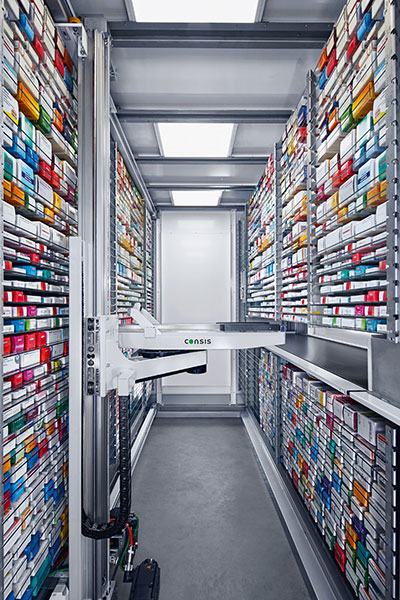
CONSIS C Willach Pharmacy Automation

As a 135-year-old family business, with a broad range of dispensary storage options, we are not wedded to selling you what’s in stock and with multiple robotic options we are not tied to one type of technology.

Our team will work with you and undertake a quantitative analysis and look at your business needs and future operational plans. During the process, we present you with information and options so that you are informed to make decisions which best suit your business.

With hundreds of robotic projects delivered in Australia, Willach have the proven knowledge, expertise, and range of products to find a solution which works for your business.

To find out how we can help, please call us on 
03-9429-8222.

CategoriesPharmacy Efficiency,  Robotic Dispensing

Automate ordering, increase efficiency, improve your cash flow

CONSIS Advanced Inventory Management Software

Save time. Save money.

“The first rule of any technology used in a business is that automation applied to an efficient operation will magnify the efficiency. The second is that automation applied to an inefficient operation will magnify the inefficiency.” – Bill Gates

Adding robotics to your pharmacy doesn’t automatically mean that your inventory becomes ‘Managed.’ The concept that you just put it all into the box and it takes care of itself is a furphy. You’ve all heard of the saying “Give a man a shed….”

Often, an inexperienced staff member or an intern pharmacist is tasked with ordering dispensary SKU’s and for fear of running out, they inadvertently over-order. A busy shopping centre pharmacy in NSW was haemorrhaging cash and we were asked to assist with a dispensary review. It was easy to see what was going on when we walked into the dispensary. The image here is $80k of overstocked SKU’s because the intern was warned not to run out of anything! Emotional decisions were increasing stock levels and costing the business. We quickly identified the concept of stock-turns, tying up cash in unsold stock and went through the process of managing stock.

When adding a robot into the dispensary, it is often viewed as the automation of tedious manual tasks within the dispensary. Lessor recognised, are the efficiencies gained with robotics in inventory management.

The quote from Bill Gates reminds us of the importance of efficiency within inventory management. The balance between having too much stock and not enough is a fine one, stock management refers to the activity of keeping a supply of the right stock at the right time. We get it, owners can’t be everywhere and over every detail of their business so the team at Willach set about creating smart software which helps your team to keep their robot and stock in check.

This new Advanced Inventory Management Software for CONSIS simplifies your ordering process, integrates with PharmX and marks the stock off invoice as it scans into the machine (dependent on your Dispense Software’s capability).

The algorithm in the software analyses the dispensed drugs over the previous 3 months and calculates a suggested order for either 7, 10 or 14 days of stockholding. Pharmacies on the trial program identified that they were holding $8-$10k less stock per week as an ongoing basis. More importantly their staff were more efficient with their time and felt less stressed in checking stock levels and making decision on what to re-order. They were no longer torn between rushes or their team just to meet cut-off times. Overall staff satisfaction was seen to improve and they were able to put their energies into service.

In addition to the ordering efficiencies, CONSIS A.I.M.S. aggregates all the standard management reports into a single summary page. It serves as a dashboard where you can filter the Advisories to view the required actions to optimise your robot. Pharmacies have reported much greater efficiencies within their machine and feel that the guess work has been taken out of stock and cash management.

If you are interested in adding the Advanced Management software to your CONSIS, please contact the office on 03-9429-8222 or your Regional Manager to arrange a 60 day free trial.

Mark Brown 0438 225 022
Mel Guise 0400 467 887
Janek Pendrakowski 0418 385 788

CONSIS C Willach Pharmacy Automation
CategoriesRobotic Dispensing

Designing Success: The crucial role of design thinking when adding robotic dispensing

In the rapidly evolving landscape of Australian pharmacy, the integration of robotic dispensing is a game-changer. However, a design focus of integration of robotics into the dispensary is often forgotten.   

Design for operational harmony

Beyond the allure of robotics, a well-planned layout is essential. Imagine a pharmacy where the workflow is intuitive, space is utilised strategically, and the robot seamlessly fits in to this. A design focus will understand your business, how you prefer to operate, looking at optimising space, and creating a conducive environment for both staff and customers. 

Operational harmony is achieved when working feels effortless and there is less stress in the team.  

Efficiency unleashed

Time is money in pharmacy. A thoughtful design ensures the robotic dispensing system integrates seamlessly, reducing stock on hand and wait times and boosting operational efficiency. From prescription drop-offs to script collection with pharmacist interaction, design unlocks the full potential of robotic dispensing, transforming a pharmacy into a place of well-being for your staff and customers. 

Prior to adding robotics, consider your drug dispensing profile, review your drug data with a set of fresh eyes and consider the impact of stock levels on your cash flow and the interaction with resources efficiencies in the dispensary.  

Customer-centric simplicity

At the core of pharmacy design is a customer-centric approach. A design should facilitate efficient dispensing while providing a welcoming atmosphere conducive to health advice. Elements like comfortable waiting, clear signage and professional consult rooms contribute to a positive customer experience. A successful robotic system isn’t just about operations; it’s about facilitating customer engagement.  

With over 300 installations across Australia and New Zealand, talk to us about how we can help. 

Pharmacy Robotics
CategoriesRobotic Dispensing

Automation Considerations in Australian Pharmacies

Pharmacy automation has come a long way in the last 25 years. Automation takes on many forms in the pharmacy – ‘Pack Dispensing’ (whole pack) and ‘Dose Dispensing’ (individual tablet) has evolved in different markets based on prescribing practices driven by Government regulations.

Pack dispensing first appeared in the market in the mid-1990’s in Europe, driven out of innovation from manufacturers in Germany. The medicines landscape in Germany, Austria and Switzerland was quite different to anywhere else in the world.

A typical German pharmacy holds over 10,000 dispensary SKU’s and the dispense frequency is quite low, a fast-moving item may be dispensed several times per day. The breadth of range is driven by each private health insurer, every company supports a different generic manufacturer. The impact on a pharmacy dispensary is therefore significant, they must hold the same molecule drug for up to 6 different suppliers and the storage required for this is costly when looking at the current retail rental costs per square metre.

Because of this set of circumstances, an automated solution known as ‘Random Chaotic’ was created. The result was a machine which stored each medication in a designated spot or compartment, based on the available pack size having an available spot in the machine. This place is determined by the machine’s brain, based on algorithms designed to use the storage space in an optimal way but seemingly ‘chaotic’ to the layman. This is where the term ‘random’ or ‘chaotic’ came from.

CONSIS.C Random Chaotic

In France, the Netherlands, UK, Spain and Scandinavia, the product portfolio was much narrower. They carried around 2,000 dispensary SKU’s with comparatively higher stock turns. These markets required a machine which could store up to 10 packages of the same medicine and operated on the same principles as a vending machine – this became known as a ‘Channel Robot.’

Consis B2
CONSIS.B Channel Robot

Channel machines can be differentiated by those which use a picking arm and those which have individual triggers at every channel. In this case the packages are not individually picked but dropped from the channels to a conveyor belt. An integrated lift then transports the packages to the respective exit chute or point. This is a particularly fast way of picking and therefore used in ultra high-volume dispensaries such as Chinese hospital pharmacies, which dispense up to 8,000 items per day.

In Australia, the average pharmacy carries 2,000 SKU’s, the top 100 drugs account for around 56% of items dispensed. It is a market which is characterised by a relatively narrow range of drugs, dispensed frequently, referred to as fast moving drugs. The generic is selected by the pharmacy owner. The slowest moving drugs i.e. dispensed once per week or less, comprises 875 SKU’s of items dispensed (25% of all items dispensed).

In the U.S.A. and New Zealand, the technology applied to achieve the same goals is different again. Most medication is dispensed at an individual pill level and in customised packaging i.e. not in manufacturer’s packs. Therefore, machines which pick individual pills and dispense them into sachets, blisters or vials have been developed, these are referred to as ‘Dose Robots.’

CONSIS.DOSE Systems

As the overview of history and different robotics types would suggest, there is no such thing as the ‘best’ machine. Considerations for determining the most appropriate dispensing automation are based on factors including pharmacy location, drug dispensing profile, instore stock management principles, capital investment approach and alignment to individual business objectives.

Willach is in the fortunate position where they have all options available and are therefore technology agnostic. By focussing on understanding each owner’s business, their objectives and creating a dispense profile, the data is input into a model which empowers owners with information to assist with making any decisions.

To speak with us about which robot is right for you, contact us or email us at info@willach.com.au

Email

Email us

info@willach.com.au

Service Line

Service line

1800 94 55 22

Opening Hours

Service line

Open 8am to 8pm AEST

About Willach

Willach is the Australian Market Leader in Pharmacy Dispensing solutions.

Willach is a family owned business that spans 4 generations and more than 130 years of history.

Account

Subscribe

Copyright © 2026  Willach Australia Pty Ltd. All Rights Reserved. ABN: 95 122 984 981

Willach Group
Add to cart