

Ok, we used the cheap headline to get your attention….
However on a serious note, one of the first questions we get asked is ‘What size robot do I need?’
At Willach we talk about the ‘Science of Storage’ which examines the interactions and levers involved in the inputs into storage considerations.
Storage capacity (size requirements) are a function of and the interplay between each of the following practical considerations:

1. Stock breadth– refers to the number of different SKU’s.
Depending on the state of current out of stocks and how vigilant you are managing generic brands, the typical retail pharmacy has a SKU breadth of 1,600 – 2,200 (the average is around 1,900 different SKU’s).
2. Stock depth – takes into account the dispense frequency to determine the appropriate stock holding and ‘spaces’ needed in a storage set-up.
I’m sure you’ve heard of the 80/20 rule, or the Pareto Principle, (suggests that roughly 80% of outcomes are derived from 20% of causes).
When we analyse dispensing history, we roughly see that of your 1,900 SKU’s, 390 of these equate to 80% of what you dispense in any given week. At a more granular level, the analysis of your dispensary data will typically show that around 105 SKU’s account for around 50% of what you dispense in a given week; that’s 5.5% of your dispensary SKU’s are responsible for 50% of dispensed medications – these are your fast movers and the products you don’t want to run low on! Applied to your pharmacy, this means that there will be many SKU’s which we would consider slow movers or dispensed less than once per week. The trick here is to make sure you are not overstocked on the slow moving lines.
3. Stock management practices – ordering frequency to calculate stock holding, size of storage and resources needed to restock.
Here we want to know your current ordering practices to help to determine how many total ‘slots’ you need to cater for at your ‘most full’ state. Here we are looking at the trade-off between a machine which might be too big which has an opportunity cost attached to it or too small, which requires more frequent loading.
4. Space available – physical area available and the cost per sqm (ROS).
If money is no object and you believe you will have excellent growth, go for the big refit and the biggest machine you can afford. More usual, however, is the request to fit a machine in between existing walls, work around strangely placed pillars, and to come up with a design which minimises refit costs. It is important to understand space restraints early on so that you are able to make decision and other trade-offs which may be required. You can use the size of machine and dispense history to calculate your return on space and compare this to the other space you have in the dispensary operations or in a retail area to help make decisions here.
5. Financial approach – this includes the initial outlay on assets and the ongoing working capital investment in stock.
Also included in this may be the way you are choosing to fund the asset purchase. Simply, what is your budget to make the capital investment, how are you going to fund it, what period of time are you looking to depreciate it and what pay back are you looking for? On an ongoing basis, what is your budget for ongoing investment into your stock.

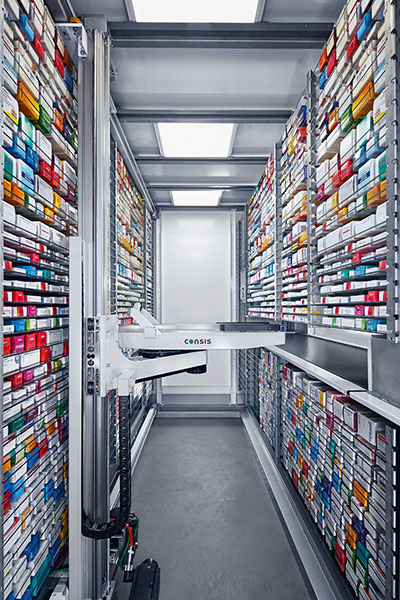
As a 135-year-old family business, with a broad range of dispensary storage options, we are not wedded to selling you what’s in stock and with multiple robotic options we are not tied to one type of technology.
Our team will work with you and undertake a quantitative analysis and look at your business needs and future operational plans. During the process, we present you with information and options so that you are informed to make decisions which best suit your business.
With hundreds of robotic projects delivered in Australia, Willach have the proven knowledge, expertise, and range of products to find a solution which works for your business.
To find out how we can help, please call us on
03-9429-8222.

